The Global Competence Thematic Research is a postgraduate course offered by the School of Journalism and Communication, Tsinghua University. It aims to lead the school’s postgraduates on field visits overseas, explore a small-scale, in-depth and practice-oriented education model, create a cross-grade, interdisciplinary, cross-regional, cross-border and cross-cultural learning environment, enhance students’ understanding of world diversity and the community with a shared future for mankind, improve their cross-cultural communication skills and global competence, and strengthen their recognition of China’s development path and the mission of contemporary Chinese youth. In this way, it cultivates outstanding young students with a global vision, a Chinese stance and youthful responsibility. The course practice team conducted research in Greece from January 16 to January 24, 2026, with the theme of "Exploring the Origins of European Civilization in Greece", exploring the historical narratives, contemporary practices and future visions of cultural exchanges between China and Greece.
This trip to Greece was an academic journey in the depths of history, a three-dimensional investigation at the intersection of reality, and a profound cultural exchange with the people and youth of Greece. Crossing Athens and Crete, we not only traced the ancient genes of Western civilization, but also felt the resonance of the two ancient civilizations of China and Greece in the present and their pulse in the future through real dialogues and youth interactions.
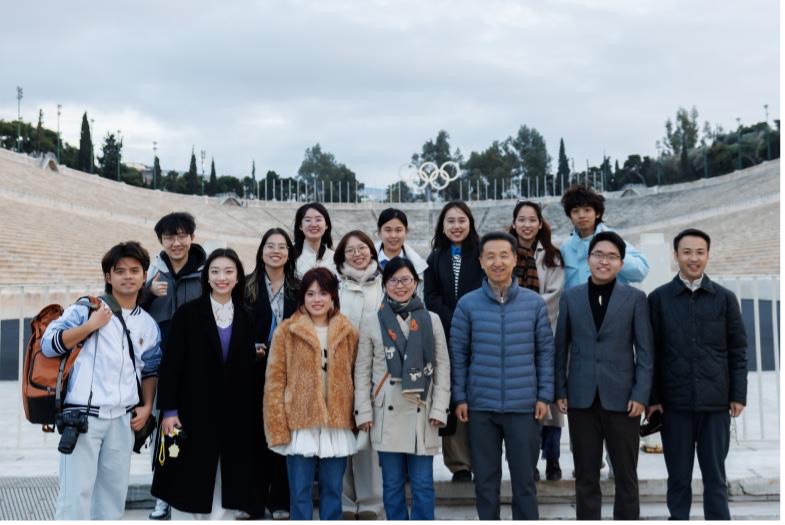
Group photo of the team in front of the Panathenaic Stadium in Athens
Tracing the Origins and Echoes of European Civilization in the Depths of History
Greece is the cradle of European civilization. The investigation of civilizational origins ran through the team’s research and formed the logical starting point for understanding contemporary Greece.
In Athens, the Acropolis temple colonnades reflect classical glory in the Aegean sunshine, the Ancient Agora ruins are the primitive footnote to democratic politics, and the Panathenaic Stadium witnesses the millennial inheritance of the Olympic spirit. The interweaving of classical architecture and modern city fully demonstrates the profoundness of civilization.
Crossing the sea to Crete, the team further explored the origins of European civilization. At the Palace of Knossos, the team faced the tension between preserving the original state and restoration. The restored ochre-red columns and bright murals make the mythical Minoan civilization tangible. The Bull-Leaping Fresco and Dolphin Fresco outline a civilization advocating nature, art and religious rituals. This "irreversible reconstruction" has become part of historical narrative, inspiring reflections on the multiple dimensions of cultural heritage "authenticity". In contrast, the Palace of Phaistos retains a "blank space" with only stone foundations and courtyard outlines, requiring observers to fill historical gaps with imagination and knowledge. The Phaistos Disc, with its unsolved spiral symbols, is a millennial secret message of civilization, reminding us of the unknown mysteries beyond human cognition. A visit to the Old Town of Chania also let the team appreciate the Palace of Kydonia ruins buried under the modern city.
From Heraklion to Chania’s archaeological museums, the team systematically observed the material heritage of the Minoan civilization. The elaborate displays and explanations weave scattered cultural relics into a coherent civilizational epic, showing how Greece transforms ancient heritage into public "civilization knowledge" through modern academic and exhibition systems.
At the Arkadi Monastery, history has become a symbol supporting the modern Greek spiritual structure. The 1866 explosion, far from the end of military resistance, marked the awakening of modern Greek national consciousness. Transformed from a battlefield into a cultural space anchoring national collective memory, the monastery has deeply participated in the spiritual construction of modern Greece.
In the depths of history, the team saw not a one-dimensional "origin of European civilization" as in textbooks, but a dynamic picture interpreted between ruins and reconstruction, silence and narration. The wisdom of ancient Greece exists not only on stones, but also in the ways people interpret them.
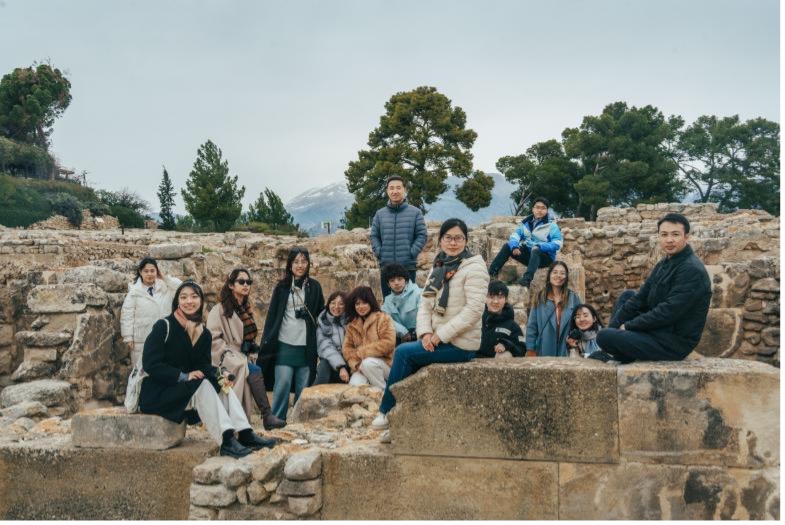
The team visited the ruins of the Palace of Phaistos.
Investigating the Present and Hope of Civilizational Mutual Learning at the Intersection of Reality
History is the root of civilization, and contemporary practice is its growing branches. Beyond cultural sites and museums, the team visited Greek institutions in politics, law, economy, education and culture, observing how classical civilization is activated for modern national governance and international exchanges, and exploring practical paths for China-Greece civilizational mutual learning.
At the legal and governance level, the team talked with George Katrougalos, former Greek Foreign Minister, at the European Public Law Organization. He analyzed the essence and institutional design of ancient Greek "democracy", and pointed out the philosophical resonance between China and Greece: the "Doctrine of the Mean" in Greek philosophy and "Harmony" in Chinese philosophy are akin to each other, and Socrates and Confucius both pursued a better society and noble personality. This deep value alignment is the solid cornerstone of China-Europe dialogue. At the Hellenic Parliament, Dimitris Avramopoulos, former European Commission Member and Athens Mayor, raised civilizational mutual learning to the responsibility of "global citizens", urging young people to resolve differences through dialogue. Their expositions show that the Greek elite is consciously transforming classical wisdom into soft power for contemporary international relations and multilateral cooperation.
At the economic and educational level, Professor Plutarchos Sakellaris of the Athens University of Economics and Business pointed out the similar concerns of Greece and China in urbanization and industrialization, and analyzed Greece’s development path after the debt crisis, as well as the differentiation and reshaping of European identity. Professor Georgios Steiris of the University of Athens offered systematic Chinese philosophy courses and found that Mencius, with its clear structure and conversational expression, is closer to the reasoning tradition of ancient Greek philosophy, especially the Aristotelian one, thus making it more easily accepted by Greek students. This proves that civilizational dialogue needs proper "interfaces", and philosophical comparison can achieve in-depth understanding of thinking modes beyond cultural surfaces.
On the front line of cultural communication, the team saw diverse subjects building a China-Greece cultural exchange network. The Aikaterini Laskaridis Foundation has cooperated with Tsinghua University since 2016, funding scholar exchanges and making young people envoys of civilizational dialogue. Xinhua News Agency’s Athens Branch runs the Greek-language "Sino-Hellenic Information Post", delivering practical economic and technological information to local readers and spreading Chinese narratives. The Sino-Hellenic Performing Arts Alliance creatively combines Chinese drama with Greek cultural symbols to build emotional connections. Professor Mo Lei (Constantinos Polymeros) of the University of Western Macedonia was drawn to China by The Art of War by Sun Tzu and chose to learn Chinese, proving that civilizational attraction starts with small opportunities and is achieved through sincere individual actions. The visit to the Chinese Embassy in Greece also provided profound inspiration for China-Greece people-to-people exchanges.
Dialogues with these institutions and scholars revealed the contemporary transformation of classical civilization and China-Greece mutual learning: classical symbols are refined into governance wisdom and international discourse at the national level; two-way philosophical and academic dialogues are deepening in academia; and cultural institutions, media and individuals are building a mutual understanding network between the two societies among the people. China-Greece civilizational mutual learning is no longer an abstract slogan, but a visible and participatory practice.
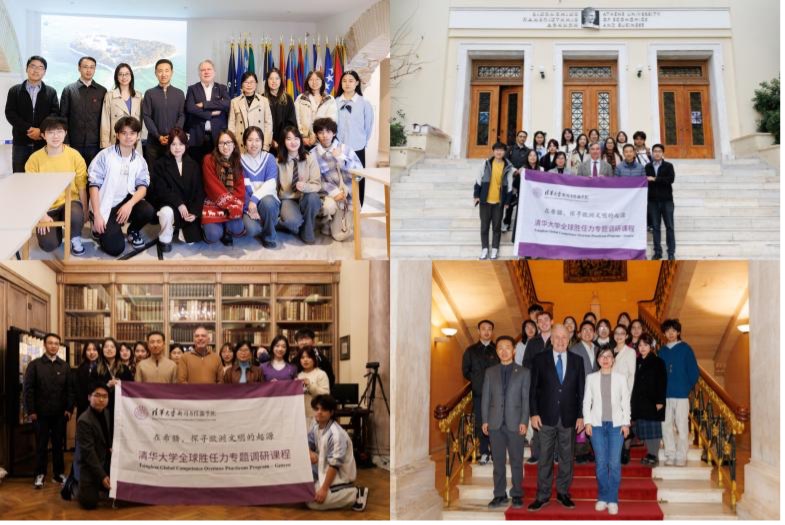
Group photos of visits to some institutions
Perceiving the Future and Direction of China-Greece Exchanges in Youth Interactions
The future of civilization belongs to youth, and the hope of mutual learning lies in people’s encounters. At two universities on Crete, the team turned from observers to participants, engaging in in-depth interactions with Greek youth and gaining precious memories.
At the University of Crete, serious academic forums and lively cultural garden parties complemented each other perfectly. Discussions on topics such as immigration policy and media empowerment reflected the concerns of Greek scholars regarding European governance. The subsequent garden party, in turn, let civilization flow in the sound of laughter and joy. At the calligraphy area, the team and Greek faculty and students wrote exclusive Chinese names and the character "Fu" (blessing) together. At the dance and music area, Chinese and Greek students taught each other dance steps, and paper-cutting works bloomed at the fingertips. The garden party turned "civilizational mutual learning" into tangible experiences, making distant cultures approachable and forging friendship through joint creation.
At the Technical University of Crete, emotional resonance reached a climax. Greek youth learning Chinese or having visited China expressed their sincere feelings for China. At the event, Chinese and Greek youth gave wonderful song, dance and recitation performances; off the stage, they talked about travel experiences and cultural observations, and made spontaneous appointments to continue their friendship. The team witnessed sincere exchanges between young people across language and cultural barriers.
Youth exchange is the most dynamic dimension of civilizational mutual learning, growing naturally through daily interactions rather than grand discourses. When Greek youth recite the Analects of Confucius in Hanfu and Chinese and Greek students dance traditional Greek dances together, sincere exchanges happen. The youthful friendship built on Crete’s campuses is an important starting point for the continuation and deepening of China-Greece cultural exchanges.
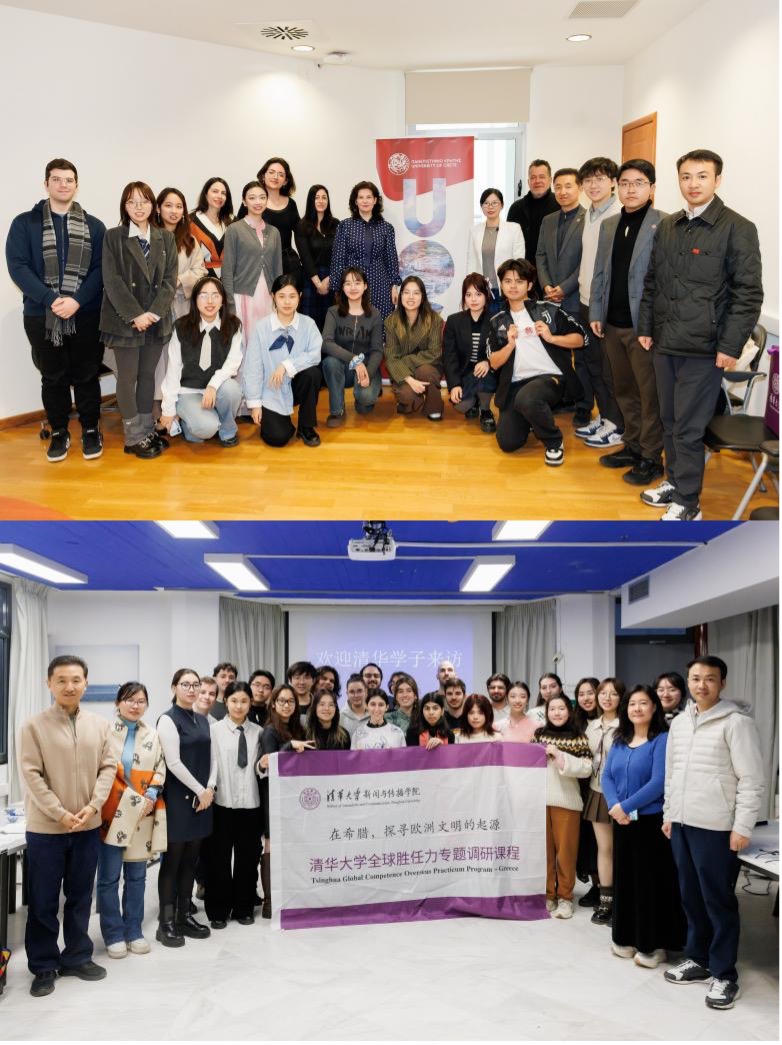
The team visited the University of Crete and the Technical University of Crete.
Epilogue: The Light of Civilization Shines Through the Ages, a Bridge of Mutual Learning Connects China and Europe
As the flight left the Aegean sky, the team took away more than just scenery and interview notes. In a world with profound pattern changes and occasional value differences, this research trip to the cradle of European civilization is not only to trace the past, but also to gain a vision for understanding differences and seeking common ground.
The vitality of civilization lies in continuous narration, transformation and dialogue. Greece has shown the team how an ancient civilization maintains vitality through diverse modern expressions—from the restoration controversy of Knossos to the archaeological blank of Phaistos, from the "global citizen" concept to foundation funding and drama innovation. Its exchanges with China have turned this vitality into a joint exploration of contemporary narratives by two ancient civilizations.
For Chinese youth, this practice is a profound identity recognition and cross-cultural exercise. Exploring other civilizations helps them reflect on their own cultural characteristics and values; telling Chinese stories hones their cross-cultural communication skills; and interacting with Greek youth lets them feel the youthful warmth of building a community with a shared future for mankind.
This trip to Greece made the team deeply realize that the light of civilization shines through the ages, and the bridge of mutual learning connects China and Europe. Standing at the intersection of two great civilizations, we are both learners and bridge builders. We must read the past engraved on stones, and more importantly, write a new chapter for the future of civilizational exchanges and mutual learning.
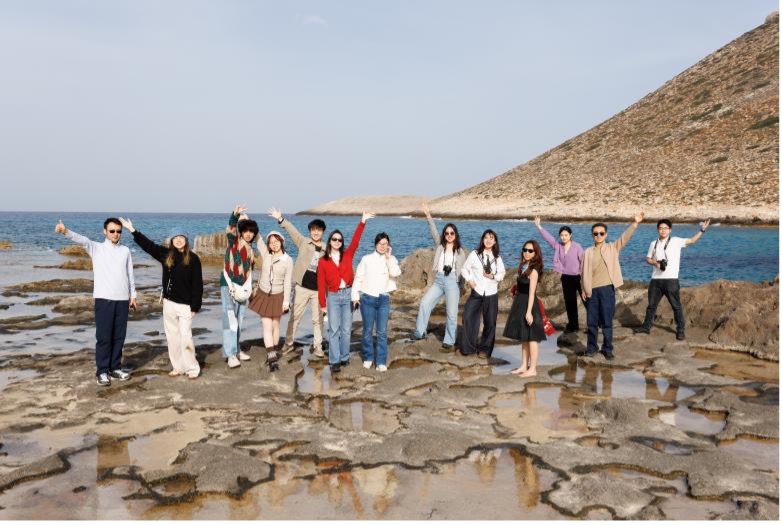
Group photo of the team on Crete