At the 18th Tsinghua Business Journalism Forum, Chinese and U.S. media leaders warned that rising geopolitical uncertainty and rapid advances in AI are heightening the stakes for accurate, cross-border economic reporting. During discussions at the National Press Club in Washington, D.C., they stressed the urgent need for deeper cooperation between journalists in both countries.

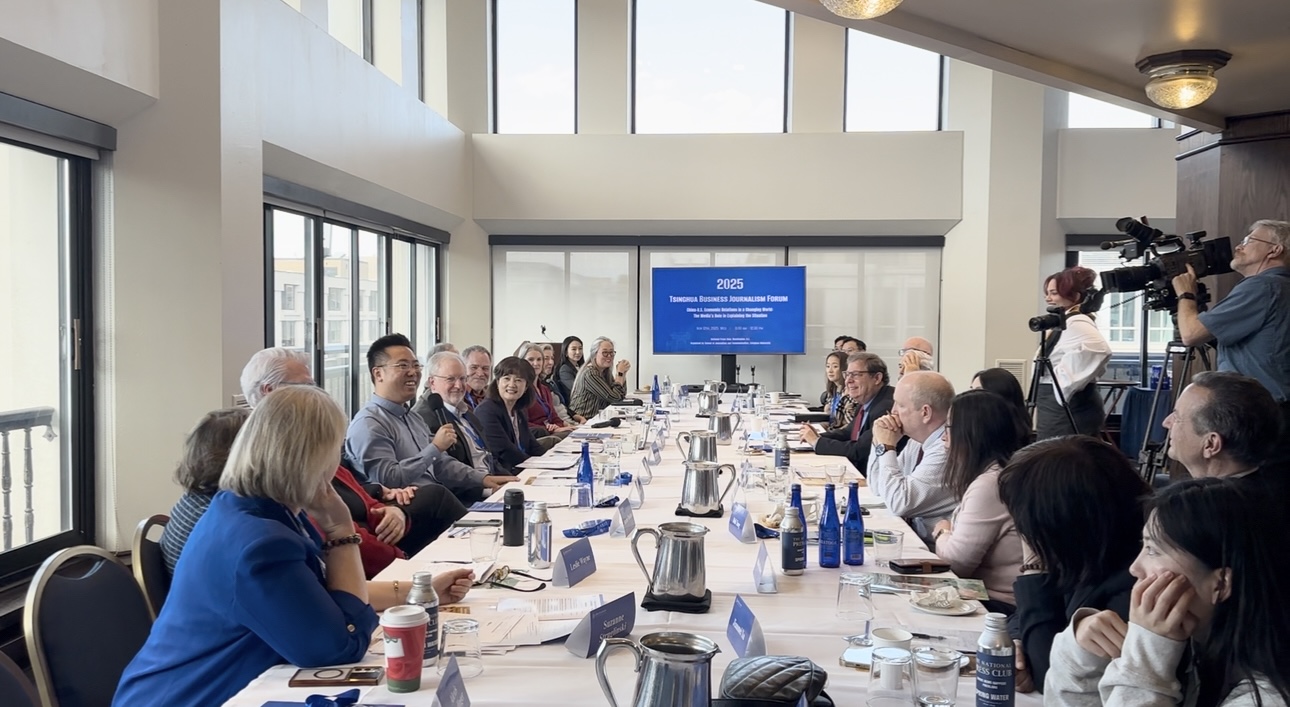
The Global Business Journalism Program was a co-host of the Tsinghua Business Journalism Forum at the National Press Club in Washington on November 12.
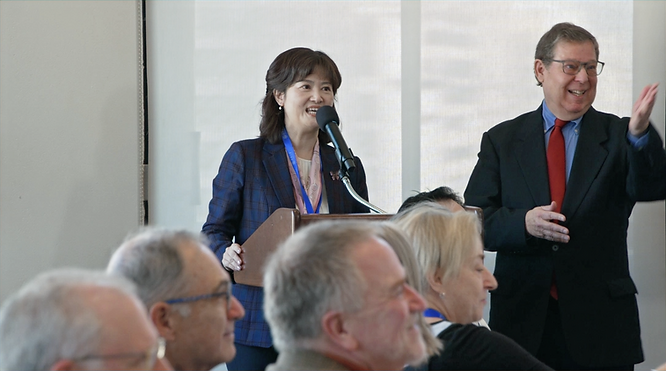
GBJ’s leadership team — co-directors Hang Min (left) and Rick Dunham — with distinguished guests at the forum.
It was the second consecutive year that the forum — GBJ's most important annual professional event — took place at the National Press Club, a storied journalism venue in the United States. Senior editors and reporters from 25 major news outlets discussed how polarization and misinformation are reshaping global narratives amid the growth of AI and social media saturation.
Speakers at the Nov. 12 forum stressed that China–U.S. economic ties remain under pressure from shifting trade policy, supply-chain instability and intensifying technological competition. Professor Hang Min of Tsinghua University emphasized the urgency of dialogue, saying it is “extremely necessary” for Chinese and American journalists to meet face-to-face during a period of technological change and global instability. Analysts added that tariffs, sanctions and public sentiment in key industries are likely to shape the next phase of bilateral economic policymaking.

Panelists at Tsinghua University’s Financial Journalism Forum calls for stronger international partnerships in journalism education.
Media leaders from BusinessWeek, CQ Roll Call, Bankrate, Caijing and Yicai cautioned that the speed of digital news cycles can undermine the depth and clarity of complex economic reporting. They warned that reactive or crowd-driven coverage risks distorting public understanding at a time when audiences are seeking stronger explanations of policies that affect global markets and technology competition.
A second major theme was the future of journalism education. Panelists called for stronger international partnerships, interdisciplinary training and updated curricula to prepare reporters for global issues such as climate change, digital finance, misinformation and artificial intelligence.
Rick Dunham, co-director of the Global Business Journalism program, noted the significance of the gathering, saying it was remarkable that media leaders from both countries could meet and speak candidly at such a pivotal moment.
The Tsinghua Business Journalism Forum has become a key platform linking academia and industry. Participants agreed that sustained China-U.S. dialogue is essential for strengthening financial journalism and improving public understanding in an increasingly polarized information environment.
Item written by Faezeh Mirzabeh